


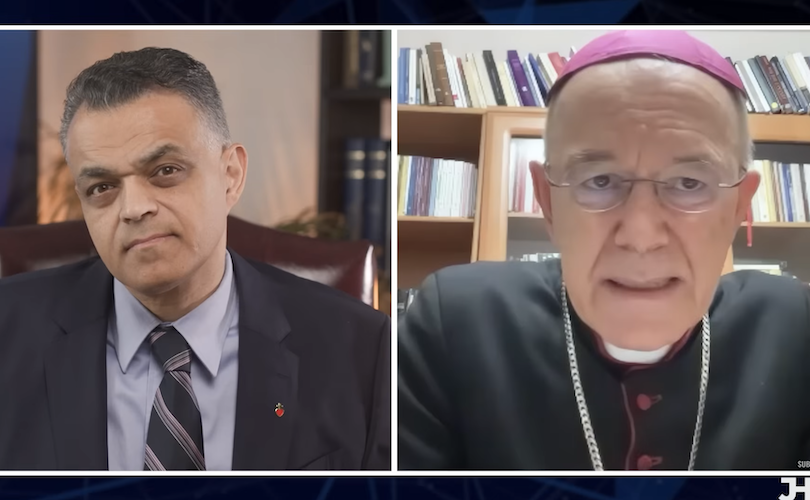
 ‘It is contrary to the apostolic tradition, to the entire tradition of the Catholic Church,’ Bishop Athanasius Schneider said about women altar servers and lectors.
(LifeSiteNews) — Bishop Athanasius Schneider told LifeSiteNews editor-in-chief John-Henry Westen in a recent interview that women and girls should no longer serve at the altar or as lectors, because doing so contradicts apostolic tradition and will inevitably lead to calls for the “ordination” of women.
During the January 13 episode of The John Henry Westen Show, the auxiliary bishop of Astana, Kazakhstan, while discussing key areas of the Novus Ordo Mass that need reform, emphasized that women should not be allowed to continue as so-called “altar girls” or as lectors (readers). Bishop Schneider said that opening these roles to women will lead to the “ordination” of female “priests” and “bishops,” as it did in the Anglican Church, and perhaps even a female “pope” if women are allowed to continue in these roles.
“The women… should (no longer), during Holy Mass, (serve at) the altar. First, I think… that they should not be acolytes or altar servers, or even lectors, readers… of the Holy Scripture during Holy Mass,” the bishop said. “It is contrary to the apostolic tradition, to the entire tradition of the Catholic Church.”
Indeed, the role of altar servers had traditionally been reserved for men and boys, with several popes expressly forbidding women from serving at the altar throughout the centuries.
As Pope Benedict XIV (1740-1758) noted in his 1755 encyclical Allatae Sunt, Pope Gelasius (492-496) had condemned “the evil practice” of “women serving the priest at the celebration of Mass.”
Despite this longstanding tradition and teaching, the Vatican, under Pope John Paul II, permitted female altar servers in the early 1990s. The Pontifical Council for Legislative Texts issued an “authentic interpretation” of Canon 230 §2 of the 1983 Code of Canon Law, ruling in favor of female altar servers.
Lectors, along with acolytes, were historically minor orders reserved for men and served as stepping stones to the priesthood. However, Pope Paul VI, in his 1972 motu proprio Ministeria Quaedam, allowed the roles of lector and acolyte as “lay ministries,” which quickly led to women in both roles.
Pope Francis went a step further by promulgating the 2021 motu proprio Spiritus Domini, which modified canon law to allow women to be officially installed as acolytes and lectors.
Bishop Schneider stressed that allowing women to serve as lectors and, worse, at the altar, introduces feminism into the “core” of the Roman liturgy and is a key step toward the ordination of female “priests.”
“(Allowing female altar servers and lectors) is giving a sign of introducing feminism (into) the core… of the Holy Mass, as a kind of promotion of giving the women access, step by step, to the Holy Ministry,” he said.
“They say first (allow women to serve as an) acolyte, and then, of course, when acolyte, why not deacon? And when deacon, why not priest? It is (logical),” he added. “And when (a) priest, why not bishop? And when bishop, why not pope? It is not a joke, it is really the (logical) consequence.”
Bishop Schneider noted that this is exactly what happened in the Anglican Church, whose archbishop of Canterbury is now a woman who supports abortion and homosexual “marriage.”
“The Anglican Church, which (now has) in Canterbury the so-called ‘lady archbishop,’ what a caricature this is,” the bishop said. “I think that they are consequential… they started with altar girls, (and are) finishing (with) a lady archbishop.”
“And when (the Catholic Church started), we started with altar girls, (for) so many years, unfortunately, even John Paul II allowed it,” he added. “And now Pope Francis introduced the (institution of female) acolytes. And… the logic(al) consequence (would) be a lady pope. We must stop this feminism in the altar room.”
Bishop Schneider highlighted that many well-meaning women and girls currently serve in these liturgical roles because they have been misled or forced by bad priests. The bishop then made a heartfelt appeal, asking them to step down from these roles and to reflect on whether the Blessed Mother would serve at the altar during Mass.
“Would you imagine that Our Lady would go to the altar and there act as ‘altar lady’ and reader (in) the pulpit? Never,” he said. “She would never, because she was conscious (this mission) was not for the female sex… She was the mother, and so her mission was to be the heart, not… to display Herself, but to be the heart.”
“And this is most important for the Church, that the women will fulfill their mission as Mary to be the loving heart and to support the Church with their true feminine characteristics: motherly, bridal,” he added. “And every (Catholic) girl… must have this basic sense of… maternity, even when she’s a virgin or will be a religious sister. She must keep this sense of maternity like Our Lady.”
Several other prominent Catholic prelates have criticized the practice of allowing women to serve at the altar, as lectors, and in other key liturgical roles. Back in 2015, Cardinal Raymond Burke, during an interview, listed women holding these roles as an example of the “feminization” of the Church and lamented how this has led to the modern decline in priestly vocations.
“The introduction of girl servers also led many boys to abandon altar service,” he said at the time. The American cardinal added that the introduction of altar girls “has contributed to a loss of priestly vocations.”
In 2024, Cardinal Albert Malcolm Ranjith, the archbishop of Colombo, Sri Lanka, echoed those sentiments about a loss in priestly vocations when he banned altar girls in the archdiocese.
“It should always be young boys (serving on the altar) because this is one of the main sources of vocations to the priesthood in Sri Lanka, and it will affect the number of candidates entering the seminaries, which risk we cannot take,” Cardinal Ranjith said.