
Introduction
The Catholic Church does not claim to invent doctrine. She claims to guard and faithfully transmit what she has received from Christ. From the moment the Apostles were commissioned, the preservation of divine revelation became a sacred obligation.
Saint Paul exhorts the faithful:
“Therefore, brethren, stand fast; and hold the traditions which you have learned, whether by word, or by our epistle” (2 Thessalonians 2:14).
https://www.drbo.org/chapter/60002.htm
This passage reveals that revelation was transmitted both in written form and through living Tradition. The Church’s mission has always been to preserve this inheritance intact, neither subtracting from it nor altering its substance.
Apostolic Origins of Catholic Tradition
Catholic Tradition begins not in later centuries, but in the earthly ministry of Christ. The Apostles received divine revelation directly from the Lord and were commanded to transmit it faithfully.
Christ declared:
“Going therefore, teach ye all nations… teaching them to observe all things whatsoever I have commanded you” (Matthew 28:19–20).
https://www.drbo.org/chapter/48028.htm
The command to teach all that Christ commanded presupposes continuity. The mission could not end with the death of the Apostles. It required succession.
This continuity was preserved through apostolic succession, by which bishops were ordained to continue the teaching authority entrusted to the Apostles. Saint Irenaeus of Lyons, writing in the second century, defended orthodoxy precisely by appealing to this succession, demonstrating that true doctrine could be traced back to the Apostles themselves.
https://www.newadvent.org/fathers/0103303.htm
For the early Church, authenticity was measured by fidelity to what had been handed down.
Scripture and Tradition as One Deposit of Faith
From the beginning, the Church understood Sacred Scripture and Sacred Tradition to form one unified deposit of faith. The Apostles preached before they wrote. The Church lived the faith before the New Testament was fully compiled.
Saint Paul instructs:
“Hold the traditions which you have learned, whether by word, or by our epistle” (2 Thessalonians 2:14).
https://www.drbo.org/chapter/60002.htm
This confirms that apostolic teaching existed both orally and in writing.
The canon of Scripture itself was discerned within the Church’s living Tradition. Councils in the fourth century identified the books of the New Testament, and the Council of Trent later reaffirmed the canon in response to Protestant challenges.
https://www.newadvent.org/cathen/15030c.htm
Without the Church’s authoritative discernment, Christians would not know with certainty which books belong to Sacred Scripture. The Bible as received today stands as evidence of the Church’s role in preserving Tradition.
The Early Church and the Defense of Orthodoxy
The first centuries of Christianity were marked by persecution from the Roman Empire and doctrinal challenges from within. Gnosticism denied the goodness of creation. Arianism denied the full divinity of Christ. Other errors distorted the apostolic faith.
The preservation of Tradition during these crises required courage and clarity.
The First Council of Nicaea in 325 solemnly affirmed that the Son is consubstantial with the Father, defending the full divinity of Christ against Arian error.
https://www.newadvent.org/cathen/11044a.htm
This was not a new teaching. It was a precise articulation of what the Church had always believed.
Saint Athanasius endured exile and opposition for defending Nicene orthodoxy. His perseverance demonstrated that fidelity to Tradition sometimes demands resistance to prevailing opinion, even within ecclesiastical structures.
Saint Vincent of Lérins later summarized the principle by which doctrine is recognized as truly Catholic: it must have been believed everywhere, always, and by all.
https://www.newadvent.org/fathers/3506.htm
This principle of universality and continuity became a safeguard against innovation.
The Role of the Fathers in Preserving Tradition
The Church Fathers did not consider themselves innovators. They saw their task as transmitting and clarifying what they had received.
Saint Augustine consistently appealed to the authority of the universal Church when resolving doctrinal disputes.
https://www.newadvent.org/fathers/1602.htm
Their writings reveal remarkable consistency in core doctrines: the Trinity, the Incarnation, the sacrificial nature of the Eucharist, apostolic authority, and the necessity of grace.
Through preaching, catechesis, liturgy, and theological reflection, the Fathers ensured that the apostolic faith remained intact despite persecution and controversy.
Tradition survived the early centuries not by adaptation to prevailing philosophies, but by steadfast adherence to divine revelation.
The Medieval Church and Organic Development
As Christianity moved from persecution into public life, new challenges arose. The Church entered the medieval period not as a persecuted minority, but as a visible force shaping civilization. The preservation of Tradition during this era required theological precision, liturgical stability, and disciplined formation.
Doctrine did not change in substance, but it was articulated with increasing clarity. The Church Fathers laid foundations that medieval theologians deepened without altering essential truths. This organic development reflected growth in understanding, not innovation in belief.
Saint Thomas Aquinas exemplifies this principle. In his Summa Theologiae, he did not invent doctrine but systematized what the Church had long held.
https://www.newadvent.org/summa/
His work demonstrates how reason serves revelation. The truths of the Trinity, the Incarnation, the sacraments, and grace remained identical in substance to those professed in the early centuries.
The medieval period also witnessed the consolidation of liturgical forms. The Roman Rite developed organically, preserving its sacrificial theology and orientation toward divine worship. The Mass continued to express the unbloody renewal of Christ’s sacrifice on Calvary, grounded in His own words:
“This is my body, which shall be delivered for you” (Luke 22:19).
https://www.drbo.org/chapter/49022.htm
Liturgical continuity safeguarded doctrinal continuity.
The Crisis of the Protestant Reformation
The sixteenth century brought one of the gravest doctrinal crises in Church history. The Protestant Reformation challenged sacramental theology, apostolic succession, and the authority of Sacred Tradition.
The Church responded not with innovation, but with clarification.
The Council of Trent reaffirmed that divine revelation is contained in both written books and unwritten traditions received from the Apostles.
https://www.newadvent.org/cathen/15030c.htm
It defined the sacrificial nature of the Mass, the necessity of the seven sacraments, and the doctrine of justification against erroneous interpretations.
In its decree on the Most Holy Sacrifice of the Mass, Trent declared that the Mass is truly propitiatory, renewing the sacrifice of the Cross sacramentally.
https://www.newadvent.org/cathen/09789c.htm
This teaching was not new. It was a defense of what the Church had always believed.
Trent also standardized the Roman Missal, ensuring liturgical unity across the Latin Church. The so-called Tridentine Mass preserved ancient elements of the Roman Rite that had matured over centuries.
In responding to doctrinal fragmentation, the Church demonstrated that Tradition is preserved through authoritative clarification, not accommodation to error.
Preservation Through Missionary Expansion
While doctrinal controversies unfolded in Europe, the Church simultaneously expanded across the globe. Missionaries carried the same faith, sacraments, and liturgy to the Americas, Africa, and Asia.
The universality of Catholic worship became a sign of doctrinal unity. A Catholic attending Mass in Europe, Mexico, or the Philippines encountered the same sacrificial theology and sacramental structure.
Christ’s command to evangelize all nations was fulfilled without altering the substance of faith:
“Going therefore, teach ye all nations… teaching them to observe all things whatsoever I have commanded you” (Matthew 28:19–20).
https://www.drbo.org/chapter/48028.htm
Missionary expansion did not produce multiple competing doctrines. It transmitted one faith.
The consistency of catechesis, sacramental practice, and moral teaching across continents demonstrates the strength of apostolic continuity.
The Preservation of the Sacraments
Throughout centuries of cultural change, the Church preserved the essential structure of the sacraments instituted by Christ.
Baptism remained the gateway to Christian life. The Eucharist remained the source and summit of worship. Holy Orders ensured apostolic succession.
The Council of Trent affirmed that the sacraments were instituted by Christ and entrusted to the Church as means of grace.
https://www.newadvent.org/cathen/13295a.htm
Despite wars, political upheavals, and social transformations, the sacramental system remained intact. This continuity reflects not human ingenuity but divine protection.
The Indefectibility of the Church
Catholic Tradition was preserved not merely through human effort but through Christ’s promise.
Our Lord declared:
“The gates of hell shall not prevail against it” (Matthew 16:18).
https://www.drbo.org/chapter/48016.htm
The doctrine of indefectibility assures the faithful that the Church cannot fail in her essential mission to preserve and proclaim the truth.
History confirms this promise. Empires have risen and fallen. Philosophies have flourished and faded. Yet the core doctrines of the Trinity, the Incarnation, the sacraments, and moral law remain unchanged.
This preservation does not imply the absence of crisis. It signifies divine fidelity in the midst of trial.
Continuity Into the Modern Era
The modern period introduced new philosophical movements, political revolutions, and cultural transformations that challenged Christian belief. Rationalism, secularism, and materialism sought to detach society from divine authority. The Church responded not by altering revealed doctrine, but by reaffirming perennial truths.
The First Vatican Council solemnly defined papal infallibility within strict theological limits, clarifying the conditions under which the Roman Pontiff teaches infallibly in matters of faith and morals.
https://www.newadvent.org/cathen/07790a.htm
This definition did not expand doctrine beyond recognition. It articulated what had already been believed regarding the Petrine office and its role in preserving unity and orthodoxy.
The Church continued to condemn modern errors that contradicted divine revelation. Pope Pius IX’s Syllabus of Errors addressed the growing influence of relativism and secular liberalism.
https://www.newadvent.org/library/docs_pi09sy.htm
Such documents reflect the Church’s consistent pattern: when confusion increases, clarity must follow.
Liturgical Continuity and the Mass of the Ages
Across centuries, the Roman Rite remained substantially stable in its structure and theology. The Traditional Latin Mass, often called the Mass of the Ages, developed organically from apostolic worship and matured through careful preservation.
Its orientation, silence, sacrificial language, and reverence emphasize that the Mass is not primarily a communal gathering but the unbloody renewal of Christ’s sacrifice.
The Council of Trent declared that in the Mass, Christ is offered in a sacramental manner, the same Victim who was offered once on Calvary.
https://www.newadvent.org/cathen/09789c.htm
This sacrificial theology remained constant from the early Church through the medieval period and into modern times.
Liturgical continuity preserved doctrinal clarity. When the structure of worship reflects the Church’s faith, belief is strengthened across generations.
The Role of the Papacy in Preserving Tradition
The papacy has played a central role in safeguarding Catholic Tradition. While individual popes vary in personality and prudential governance, the office itself exists to protect unity in doctrine.
Christ’s promise to Peter remains foundational:
“I have prayed for thee, that thy faith fail not” (Luke 22:32).
https://www.drbo.org/chapter/49022.htm
This promise assures the faithful that the Petrine office serves as a stabilizing principle within the Church’s historical journey.
Throughout doctrinal controversies, popes have convened councils, clarified teaching, and condemned error. Their authority operates within the deposit of faith. No pope may invent doctrine, but he may clarify and defend what has been handed down.
The preservation of Tradition depends not upon personal innovation but upon fidelity to divine revelation.
Tradition in Times of Turmoil
The twentieth century witnessed unprecedented global upheaval. World wars, ideological regimes, and cultural revolutions reshaped societies. Within the Church, debates over theology, liturgy, and pastoral application intensified.
Yet the essential doctrines of the faith remained unchanged.
The Trinity, the divinity of Christ, the Real Presence of the Eucharist, the immorality of grave sin, and the necessity of grace continue to be taught as they were in earlier centuries.
Periods of confusion do not negate the Church’s indefectibility. Rather, they reveal the importance of returning to foundational sources.
Saint Paul warned of times when sound doctrine would not be endured:
“For there shall be a time, when they will not endure sound doctrine” (2 Timothy 4:3).
https://www.drbo.org/chapter/62004.htm
The preservation of Tradition in such times requires fidelity, patience, and clarity.
The Principle of Continuity as Safeguard
The thread uniting every era of Church history is continuity. From the Apostles to the Fathers, from medieval theologians to the Council of Trent, from missionary expansion to modern doctrinal clarification, the Church has preserved what she received.
Saint Vincent of Lérins articulated the enduring standard: true Catholic doctrine is that which has been believed everywhere, always, and by all.
https://www.newadvent.org/fathers/3506.htm
This principle does not deny legitimate development. It ensures that development never contradicts prior truth.
When continuity is maintained, the Church flourishes. When continuity is obscured, confusion arises.
Conclusion
Catholic Tradition was preserved through persecution, heresy, cultural upheaval, and philosophical challenge because it did not originate from human invention. It originated in Christ.
Through apostolic succession, conciliar clarification, theological precision, liturgical continuity, and papal guardianship, the Church has transmitted one faith across centuries.
Empires have fallen. Civilizations have shifted. Yet the Creed professed today echoes the faith of the early martyrs.
The preservation of Catholic Tradition is not a historical accident. It is the fulfillment of Christ’s promise to remain with His Church until the end of the world.
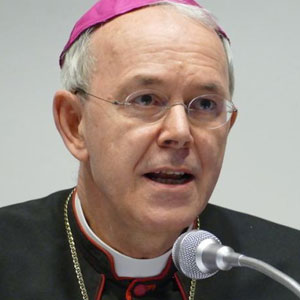
See how the faith has endured through history and deepen your understanding with clear answers in our Q&A with Bishop Athanasius Schneider: https://www.gloriadei.io/q-and-a/
Footnotes
- Holy Bible, Douay-Rheims Version, 2 Thessalonians 2:14.
- Holy Bible, Douay-Rheims Version, Matthew 28:19–20.
- Saint Irenaeus of Lyons, Against Heresies, Book III, Chapter 3.
- Council of Trent, Session IV, Decree Concerning the Canonical Scriptures.
- First Council of Nicaea (325), Definition of the Divinity of the Son.
- Saint Vincent of Lérins, Commonitorium.
- Saint Augustine, On Christian Doctrine.
- Holy Bible, Douay-Rheims Version, Luke 22:19.
- Council of Trent, Session XXII, Doctrine on the Sacrifice of the Mass.
- Council of Trent, Session VII, Decree on the Sacraments.
- First Vatican Council, Pastor Aeternus.
- Pope Pius IX, Syllabus of Errors.
- Holy Bible, Douay-Rheims Version, Matthew 16:18.
- Holy Bible, Douay-Rheims Version, Luke 22:32.
- Holy Bible, Douay-Rheims Version, 2 Timothy 4:3.
Bibliography
Sacred Scripture
- Holy Bible. Douay-Rheims Version.
https://www.drbo.org
Ecumenical Councils
- First Council of Nicaea (325).
https://www.newadvent.org/cathen/11044a.htm - Council of Trent. Session IV, Decree Concerning the Canonical Scriptures.
https://www.newadvent.org/cathen/15030c.htm - Council of Trent. Session VII, Decree on the Sacraments.
https://www.newadvent.org/cathen/13295a.htm - Council of Trent. Session XXII, Doctrine on the Sacrifice of the Mass.
https://www.newadvent.org/cathen/09789c.htm - First Vatican Council. Pastor Aeternus.
https://www.newadvent.org/cathen/07790a.htm
Fathers and Doctors of the Church
- Saint Irenaeus of Lyons. Against Heresies.
https://www.newadvent.org/fathers/0103303.htm - Saint Augustine. On Christian Doctrine.
https://www.newadvent.org/fathers/1602.htm - Saint Thomas Aquinas. Summa Theologiae.
https://www.newadvent.org/summa/ - Saint Vincent of Lérins. Commonitorium.
https://www.newadvent.org/fathers/3506.htm
Papal Documents
- Pope Pius IX. Syllabus of Errors.
https://www.newadvent.org/library/docs_pi09sy.htm