


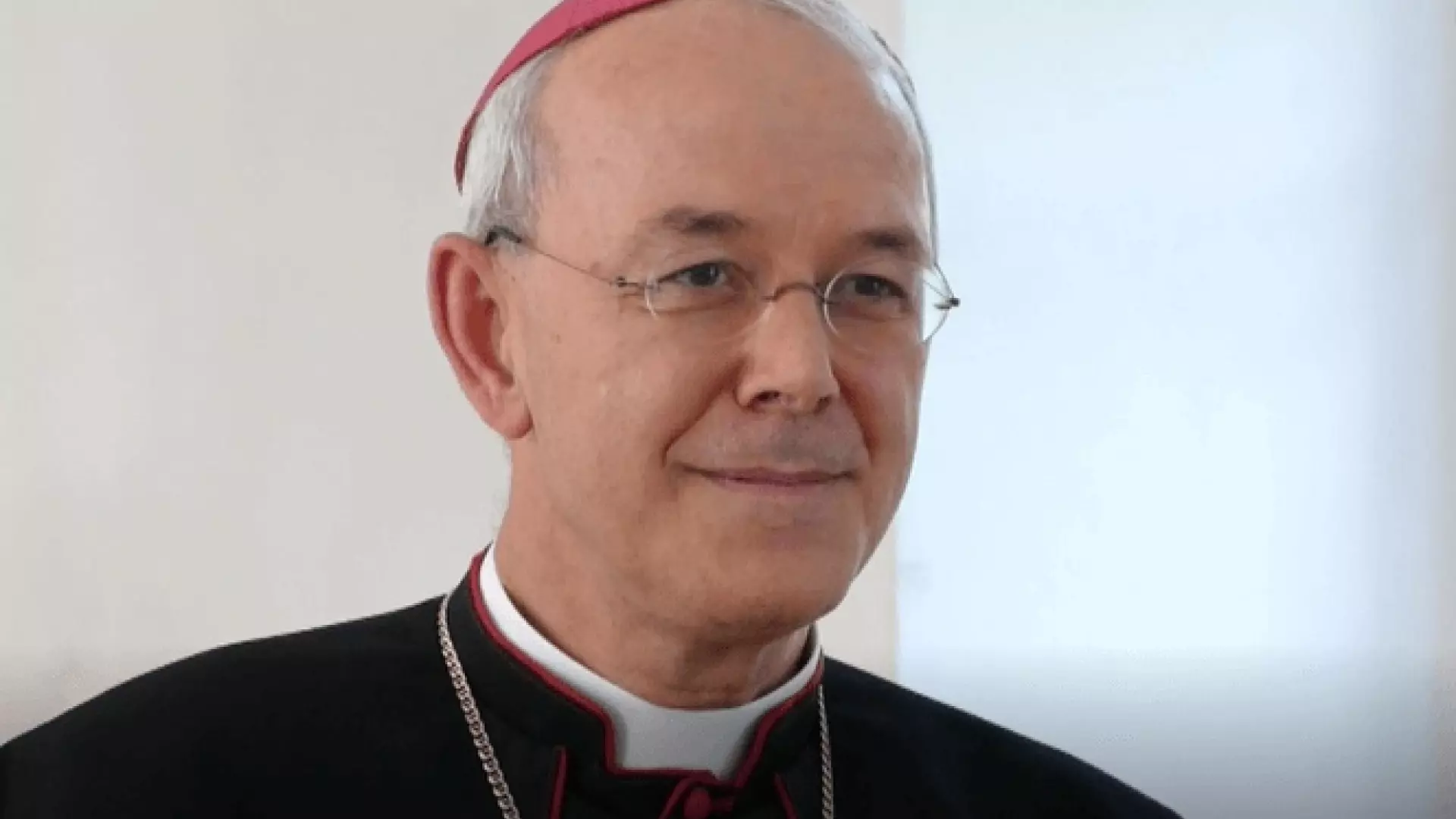
 Bishop Athanasius Schneider, Auxiliary Bishop of the Diocese of Astana, recently granted an interview to The Remnant and another to Certamen. In these interviews, he calls upon his colleagues in the episcopate to reconsider their stance on the Society of Saint Pius X (SSPX), viewing the episcopal consecrations scheduled for this coming July 1st as a benefit to the Church, and making no secret of his hope that Archbishop Lefebvre might one day be canonized.
A Perspective Shaped by Direct Knowledge of the Society
On March 25, 2026—marking the 35th anniversary of the death of Archbishop Lefebvre—journalist Michael J. Matt welcomed diocesan Bishop Athanasius Schneider to the microphone of the American media outlet The Remnant TV. Bishop Schneider explained his personal journey since the day he was appointed as the Vatican’s official visitor to the SSPX:
“Pope Francis asked me, and then three other bishops, more than ten years ago, in 2015, to visit several houses of the Society and seminaries. I was one of those bishops entrusted officially by the Holy See.
So I had direct knowledge of the reality of the Society, living with them for several days across various houses, and speaking with the superiors, professors, and seminarians. Furthermore, to prepare myself for this mission, I read many documents: a massive biography spanning over 800 pages, as well as the documents and pastoral writings of Archbishop Lefebvre, covering the entire period from his episcopal consecration in 1947 until his death.
I truly devoted many months to reading through all these documents. I also had access to additional documents within the archives of the Holy See, as this was a necessary part of the work I had been tasked to perform.” I have therefore had knowledge of this matter through various means—and, I believe, to a rather significant degree.
Since then, I have maintained regular contact with several houses, superiors, priests, and even families of the Society. And the more the crisis of the Church is progressing before our very eyes, the more I am convinced that Archbishop Lefebvre’s work—he himself and the Society—is a work of the Church, one that Divine Providence gave us in these extremely confused and difficult times.”
The 1988 Consecrations and Those of 2026
Examining the motives and intentions behind the episcopal consecrations conferred by Archbishop Lefebvre in 1988 without a pontifical mandate, Bishop Schneider discerns a continuity with those that the SSPX plans to confer—likewise without a pontifical mandate, as of this writing—on July 1, 2026:
“As Archbishop Lefebvre repeatedly stated, and the superiors of the Society continue to reiterate today, they do not view themselves as a work only for them, but they consider it all as a service for the Holy Church, for the entire Church, and indeed to the Holy See itself.
When Archbishop Lefebvre consecrated the bishops in 1988, he said: ‘I am doing this for the popes.’ That the integrity of everything that the Church—the Roman Church and the Popes—had strictly commanded to be observed up until the Council might be preserved: the Faith, the liturgy, and priestly formation, exactly as the Church had commanded for centuries.
He would say: ‘We are doing nothing other than what the Church has asked and commanded for centuries.’ How, then, could we be doing something wrong if this is precisely what the Church considered, and even, I repeat, indeed strictly demanded required, for centuries, and which produced saints? This priestly formation, spanning centuries—how could it suddenly be harmful or incorrect?
And the Archbishop would add: ‘We have introduced absolutely nothing new; only what the Church desired.’
The goal was to transmit this heritage through this time of confusion, a confusion that is only temporary. Because we must firmly believe that the gates of hell shall not prevail against the Holy See. The current situation is a kind of “Avignon exile,” if I may speak in spiritual or metaphorical terms. The crystal clearness of the papal Magisterium and of the Chair of Peter has been obscured. The liturgy, too. And all of this, even Rome itself, which ought to be the light and the rock, is obscured.
This in no way implies sedevacantism. Rather, it signifies simply that something has been obscured—much in the same way that, during the Avignon period, there were true popes, yet they were not in Rome. Rome remained vacant for seventy years. Symbolically, the situation is much the same today: the Holy See is partially obscured by the influence of neo-modernism, which is a movement characterized by naturalism and relativism. But this is only temporary.
The Holy See will once again regain all the clarity, all the strength, and all the vigor of the Catholic Faith and of the Holy Liturgy. All of this will return. And Archbishop Lefebvre was deeply convinced of this.
Even after the 1988 consecrations, he would sometimes say that, before long, we would once again have a strong, traditional pope in Rome. And then, he would say, you bishops will go to him, you will offer him your episcopate, and you will say to him: ‘Most Holy Father, take our episcopate; do with us whatever you wish.’ For at that point, our episcopate would no longer be necessary, since that task would once again be assumed by the Holy See and by the pope himself.
I believe that, with this same intention and in this same spirit, the Society will do the very same thing this year: offer these new bishops as a bridge, in these very dark times, but a bridge for Holy Church, for Rome, and for future popes. And when, one day, I repeat, there is once again a 100% traditional pope—for such is the very essence of the papacy: to be 100% traditional—and this will come in God’s own time, we do not know when, but it will surely come, then, I imagine, the new bishops consecrated within the Society this July will likewise go to him and say: ‘Most Holy Father, our episcopate is no longer necessary; you are now fulfilling this task. Do with us whatever you wish.’
Such was the attitude of Archbishop Lefebvre, and I believe that it remains the attitude of the Society today, just as it has proclaimed, and as its Superior General, Fr. Pagliarani, wrote to Pope Leo. Such an attitude is in no way schismatic.”
A Refutation of Accusations of Schism
Bishop Schneider sought to defend the SSPX against the recurring accusations of schism leveled against it:
“We must, therefore, correct our understanding of schism. In recent centuries, we have held a very reductive view of schism, a completely legalistic view. We have also held a reductive view of obedience. We have even absolutized obedience to the pope, who is a creature; the pope is not God.
In reality, I must say this, there exists within the psychology of many people, traditionalists or conservatives, and even among certain bishops and cardinals to this very day, a kind of implicit divinization of the pope. I emphasize implicit, not formal or explicit. Consequently, any act of disobedience is immediately labeled: ‘You are a schismatic,’ simply because you have disobeyed.
This concept was foreign to the great tradition of the Church. It was completely foreign to the Church Fathers. I am a patrologist, and I can state this with authority. When St. Athanasius disobeyed Pope Liberius, who subsequently excommunicated him, that excommunication was, of course, formal in nature, in accordance with the law. Yet I maintain that, in the eyes of God, excommunication was invalid. How could Pope Liberius, who had, to a certain extent, cooperated with semi-Arian ambiguity, possibly excommunicate the greatest defender of orthodoxy? In the eyes of history, the excommunication of Athanasius was unjust, and I believe that, in the eyes of God, it was invalid.
That is why I believe that, regarding the current issue of the Society and these consecrations, there is something providential at work. God permits it because we are a large family, and society is part of our family. It does not exist outside the Church. As you have noted, it names the pope in the Canon; it also names the local bishop in the Canon. It has received faculties from Rome to hear confessions, faculties that remain valid and unrevoked. How could a schismatic community possess valid faculties for confession? For that constitutes a form of jurisdiction.
Pope Francis has even asked bishops and pastors to grant them the possibility of canonically assisting at marriages. And, indeed, they are able to do so. Furthermore, in certain very grave cases involving priestly misconduct, it happened, at the time of my visit, that Bishop Fellay reported to me that a specific case had been referred to the Holy See; and the Holy See thereupon delegated Bishop Fellay to act as judge, in the name of the Holy See, to conduct the canonical investigation. How could a schismatic do such a thing?
We must, therefore, recover a more balanced view of what is schism and what is obedience within the Church. Not every act of disobedience toward the pope is automatically schismatic. And even an episcopal consecration performed against the pope’s will, and thus illicit in that specific instance, is not, per se, an intrinsically evil act. Certain representatives of traditional communities established under the Ecclesia Dei framework have publicly asserted that an illicit episcopal consecration, against the pope’s will, would constitute an intrinsic evil. This is completely wrong. It was never taught by the great Tradition of the Church.
For instance, the Servant of God Cardinal Josyf Slipyj, of the Greek Catholic Church, and now recognized for his heroic virtues, secretly consecrated three bishops in Rome, acting against the will of Pope Paul VI and knowing that Paul VI would not allow it. Should we, then, conclude that the Servant of God Josyf Slipyj committed an intrinsic evil and incurred automatic excommunication? Certainly not.
We must, therefore, return to the great, balanced view of the Church Fathers in the first millennium. Consequently, the intention of the Society is clearly non-schismatic, repeatedly, and they only do it as a service to the Church and to the papacy. And I think that later, once this immense crisis has passed, the Church will be grateful to the Society.”
The SSPX’s Distinctive Freedom
Going further, Bishop Schneider expressed his gratitude to the SSPX for the liturgical struggle it is waging in the service of the Church, a struggle he himself embraces, while highlighting the unparalleled freedom the Society currently enjoys:
“Archbishop Lefebvre, out of love for the Church, accepted the burden of undertaking this task, even at the cost of being suspended by the pope. At the time, fifty years ago, in 1976, in that context, a high-ranking representative of the Holy See said to Archbishop Lefebvre: ‘Our problem is the Mass.’
At that moment, the primary focus was not yet on the doctrinal issues of the Council; rather, it centered on the Holy Mass, specifically, the Traditional Mass. And this high-ranking representative of the Holy See said to the Archbishop: ‘If you would only agree, just once, to publicly celebrate the Novus Ordo, before your seminarians and the faithful, then all our problems would be resolved.’
But he refused. He said: ‘My conscience does not permit it.’ For to act in such a way would be to embrace ambiguity.
He acknowledged that the Novus Ordo is valid, always on the condition that it is celebrated in accordance with the rules in the Missal. Yet, even when celebrated in Latin and strictly according to the rubrics, it contains within itself elements of profound ambiguity, most notably the Offertory prayers and the Second Eucharistic Prayer, which significantly dilute the sacrificial and propitiatory character of the Holy Mass, even though it is yet the same Sacrifice of Calvary. This places the primary emphasis on the Mass as a meal.
Now, this is a grave matter. We cannot simply say: ‘Let the Novus Ordo be celebrated in Latin or ad orientem, and everything will be resolved.’ That is not sufficient. These two elements are, in reality, highly ambiguous. And we cannot tolerate, in the central and most sublime act of the Church—which is the sacramental representation and actualization of the Sacrifice of Golgotha, the greatest act of adoration rendered to God on earth—that this act be tainted by doctrinal ambiguity.
I am not saying that the Novus Ordo is heretical, no. But it severely weakens doctrine. The Church cannot afford to continue in this manner. That is why the Society renders an immense service to the future of the Church by highlighting these doctrinal ambiguities within the Novus Ordo and calling upon the Holy See to correct them.
The other communities—the so-called Ecclesia Dei communities—which celebrate the Traditional Mass, do not dare to say this. If they were to begin making such demands, they would find themselves facing an apostolic commissioner the very next day and would be brought to heel. We have witnessed this in recent years: three flourishing parishes belonging to the Fraternity of Saint Peter in France were shut down by their bishops, and all their appeals to the Holy See went unanswered. The Holy See offered them no assistance.
I was even recently informed, by a reliable source, of the case of another Ecclesia Dei institute in Europe: they were already established in a diocese with the permission of the previous bishop. They asked the new bishop to formalize their presence through a canonical foundation, something a bishop is empowered to grant on his own authority, without seeking permission from Rome. Canon law explicitly provides for this. Yet, this bishop decided to consult Rome nonetheless, asking: Should he officially recognize and establish this community within his diocese? And Rome replied: “Do not grant them this recognition.” Such is the situation, the reality.
Three Major Doctrinal Points
Bishop Schneider identifies the same fundamental doctrinal errors as the SSPX, which, since Vatican II, require thorough examination within the Church in order to be corrected:
“Furthermore, there are other doctrinal elements that must be discussed and debated within the Church. One cannot simply say: ‘Let us resolve this using the famous hermeneutic of continuity.’ No. That is not intellectually honest. It is an attempt to square the circle. I call it mental acrobatics. It does not work, and it is unconvincing. It allows ambiguity to persist.
The Church cannot afford to remain in a state of doctrinal ambiguity. And the themes in question are primarily three in number.
The first is so-called religious liberty, as it has been formulated. When read plainly, just as it stands, it is highly ambiguous and fosters relativism. The notion that all religions possess an equal right to be propagated and tolerated, a right which is held to be not only a civil right, but one rooted in the nature of the human person, and therefore a natural right. Yet natural law is positively willed by God. And God cannot positively will that idolatrous religions possess the same right to spread as the one true religion He has commanded for all of humanity: the Catholic religion.
It is, therefore, ambiguous and relativistic, and this is evident to anyone who reads it. And the consequence of the so-called ‘spirit of the Council,’ as you have mentioned, is that this specific expression found in Dignitatis Humanae has been interpreted, in almost every faculty of theology and in seminaries worldwide, as meaning, in substance, that all religions possess equal rights and equal dignity, as if they were all equally valid paths to God. This is precisely what Pope Francis himself articulated in Abu Dhabi.
Moreover, on the return flight, a journalist asked him whether this assertion within the Abu Dhabi document—according to which God, in His creative wisdom, wills the diversity of religions—was not relativistic. Pope Francis replied in the negative, stating that this sentence was not a millimeter away from what the Council had taught about religion. In this regard, at least, he was being honest.
Consequently, some traditionalist priests have written entire books of five hundred pages or more in an attempt to square the circle and explain that all of this can, in fact, be interpreted in a traditional sense. Yet, the mere fact that a single sentence requires one hundred or five hundred pages of interpretation is, in itself, a clear indication that something is amiss, that a grave ambiguity exists, and that it stands in need of correction.
This formula, according to which every human being is free to choose his religion in accordance with his conscience, without being prevented by anyone, to profess, practice, and propagate it, individually and collectively, and that this right is rooted in human nature, this formula is applicable solely to the Catholic faith. In the case of other religions, a qualification must be added: there must be tolerance, certainly, but that is not the same thing.
The Church has said it since the Church Fathers. St. Augustine, among others, stated it clearly: one cannot place the pagan religions of the Roman Empire on the same level as faith in Jesus Christ. Christians died for this. Therefore, this point must be corrected.
The second point concerns false ecumenism. The assertion that other Christian communities are, as communities, instruments of the Holy Spirit in the work of salvation, this formula effectively relativizes the unique status of the Catholic Church, placing it, de facto, on almost the same level as other Christian communities.
It would be more accurate to say that the Holy Spirit may use certain individuals within these communities as instruments of salvation. However, one cannot claim that their structures themselves, which are objectively heretical or schismatic, serve, as such, as instruments of salvation. Here again, the language is highly ambiguous. And we can see the fruits of these ambiguities in interreligious dialogue and ecumenism: a constant relativization of the uniqueness of the Catholic Church.
Then there is that other formulation found in Lumen Gentium 16, according to which we Catholics worship the one true God together with Muslims. How could we possibly worship together with Muslims? It is impossible, even from the standpoint of the very nature of the act of worship. On the supernatural plane, a Christian’s act of worship is always that of a child of God. In contrast, the act of worship performed by a Muslim, however sincere, and even if he is unfamiliar with the Quran as a specific text and simply wishes to worship the Creator, remains of a different order. He does not possess divine filiation through baptism and faith. His act of worship is, therefore, essentially different from ours.
How, then, can one declare in a single breath: ‘We worship together with Muslims?’ It is impossible. And, at the very least, it is highly ambiguous. Furthermore, if we worship the same God together with Muslims, why evangelize Muslims? That is the logical consequence. And why seek to convert Protestants or schismatics to the Church, if their communities are also, as the Council states, instruments of the Holy Spirit for salvation?
For sixty years, these have been the fruits of such highly ambiguous formulations: we have arrived at a state of complete confusion and a total relativization of the truth.
The third serious point concerns so-called collegiality, that is, this entirely novel doctrine, which has never been taught by the Church Fathers or by the popes prior to the Council, according to which the College of Bishops, with the pope, permanently possesses supreme authority over the entire Church. This is an innovation. It has never been taught before. And it is contrary to the Gospel.
Our Lord addressed His words to a single individual: ‘Feed My sheep… feed My lambs,’ meaning the bishops and the entire flock. He did not address this command to Peter and the other Apostles collectively. He could have said: ‘Peter, and you other Apostles along with him, feed My flock.’ But he did not say that.
Consequently, the teaching on collegiality in Lumen Gentium, in this sense, undermines both Catholic Tradition and the Gospel on the monarchical structure of the Church, which God established. There is one Head over the universal Church: Peter, the papacy. And there are bishops at the head of the local Churches. There exists no intermediate body, divinely instituted, that permanently exercises collective, supreme governance over the universal Church.
This is possible only in specific instances, when the pope deems it useful to allow the College of Bishops to share in his unique, supreme authority, for example, during an Ecumenical Council or a particular Synod to which he grants universal scope. This rests entirely with the pope; he cannot be compelled to do so.
Throughout history, popes have, of course, always recognized that they also serve as the Head of the College of Bishops. They have consulted the bishops in various ways in history, in synods or councils. Yet, this in no way changes the monarchical structure of the Church.
These three doctrinal questions are, therefore, important. They must be resolved. In this regard, the Society of Saint Pius X serves as an immense aid to the entire Church, for it compels us to confront these doctrinal issues, as well as the issue of the Novus Ordo, with honesty and candor. This will undoubtedly take time. But the Church has time.
That is why I addressed this appeal to Pope Leo: ‘Please, build a bridge. Grant the apostolic mandate for these episcopal consecrations. This would mark a crucial first step toward integration and normalization.’ The canonical status of the Society would not yet be fully resolved; that could follow at a later stage. However, taking this initial step would immediately foster a climate of mutual trust for the debate that must take place within the Church, with the assistance of the Society of Saint Pius X.
I hope, and I pray until my last day, for the miracle that Pope Leo might grant this permission for the episcopal consecrations. We must believe with the simple faith of children and pray that this is, indeed, the right course of action for the pope to take in these circumstances.”
Attacks Against the SSPX Within the Traditionalist World
Bishop Schneider deplores the criticisms directed at the SSPX by other traditional or conservative currents, calling for a more fraternal and constructive attitude in the current context of crisis:
“And I also deplore the fact that, in this context, many traditional communities and certain bishops or cardinals known for their love of Tradition have begun to publicly attack the Society of Saint Pius X, labeling it schismatic or threatening it with excommunication. This doesn’t help at all. It should be the other way around.
Amidst this immense confusion within the Church, with this relativism, and the ever-increasing instances of blasphemy and sacrilege during the celebration of the Mass; with bishops and cardinals who publicly proclaim heresies without being punished, who call for the ordination of women, or who announce that they will soon ordain married priests, all without being reprimanded, or even warned; not to mention the German ‘Synodal Path,’ which completely undermines the structure of the Church in an attempt to remodel it after a Protestant community, a situation in which Rome has failed to intervene for years; in this context where the world is becoming increasingly anti-Christian, with the global imposition of gender ideology and the normalization of homosexuality, and a growing Islamization in Europe…
Recently, for instance, the Spanish Prime Minister declared that if anyone in Spain were to criticize Islam or the Prophet Muhammad, that person could face up to five years in prison. Yet he made no such statement regarding someone who might insult Jesus Christ. Such is the situation we face.
In such a context, we should unite all those who still uphold the integrity of the Catholic faith, of priestly formation, and of the Holy Mass, which is precisely what the Society seeks to do. As early as November, the Superior General, with prudence and respect, asked the pope not to oppose these consecrations. This initial request was brusquely refused. Yet they are still trying, and I believe they will formally request it once again.
In this context, I deeply deplore these attacks coming from within traditionalist circles themselves. This reminds me of the situation in the fourth century, during the Arian crisis, which St. Basil the Great described as a naval battle fought at night, in the fog, where, instead of attacking enemy vessels, the good end up attacking one another.
I consider our situation to be much the same. Why should the Priestly Fraternity of Saint Peter, or other groups, publicly attack the Society of Saint Pius X, threatening it or labeling it as schismatic? On the contrary, they should say to the Holy Father: ‘Most Holy Father, we believe you should make a generous gesture. Grant them, on an exceptional basis, permission for these consecrations.’ This is a matter of ecclesiastical law, not divine law. Then, slowly, step by step, we will integrate them and engage in dialogue with them. It will take time.
This is precisely what all the Ecclesia Dei communities should be doing. But, instead, they attack. And they risk going down in history just as St. Basil described those who, in the midst of a crisis, attacked their own brethren.”
An Appeal for the Recognition of Archbishop Lefebvre
Bishop Schneider made no secret of his admiration for the intrepid prelate that was Archbishop Marcel Lefebvre, expressing the hope that he might one day see him raised to the altars:
“I would like to invite all the various entities within the Church, the Fraternity of Saint Peter, which I hold in high esteem and which is doing excellent work; the other institutes; and the good bishops, to unite more closely, and to adopt a more fraternally positive attitude toward the Society of Saint Pius X, so that together we may form a unified force to restore our Holy Mother the Church amidst this unprecedented crisis.
Furthermore, we must pray for the Pope, asking God to enlighten him. The pope ought to be the head of Tradition; he is, by his very nature, the head of Tradition. And this will come to pass. We must ask for it with persistence.
I believe that regarding the upcoming episcopal consecrations—though I continue to hope, right up to the very last moment, that the pope will make a generous gesture—even if this does not happen, that God will permit it for the good of the entire Church. Divine Providence knows how to make use of all these things.
We must place our great trust in Divine Providence and in Our Lady, who is the Mother of the Church. We must implore her aid. And we must also implore the aid of Archbishop Lefebvre. Tomorrow marks the anniversary of his passing. I am convinced that, one day in the future, he will be recognized by the Church as a great bishop. Indeed, I do not rule out the possibility that, one day, he may even be canonized as a Confessor-Bishop who stood firm during times of great difficulty, he who always loved the Holy See and the popes, despite having been persecuted, suspended, and excommunicated; he who, until the very end, prayed for the pope and loved the Holy See and Holy Mother Church.”
A Critique of “Papalism”
In another interview—this time a written one—granted to the Austrian media outlet Certamen, Bishop Schneider lamented a form of “divinization” of the pope’s authority among certain Catholics:
“Over the last few centuries, an erroneous and anti-traditional interpretation of two dogmas from the First Vatican Council has become widespread: the pope’s primacy of jurisdiction and pontifical infallibility. This has resulted in a form of ‘papalism,’ that is, an absolutization, or even a quasi-divinization, of the person of the pope, making him the center of the entire life of the Church, to the detriment of the centrality of Christ and of rootedness in Tradition. In such an excessive view, any act of disobedience toward a pontifical decision is regarded as schism.
Furthermore, a flawed understanding of pontifical infallibility has taken root, leading people to regard de facto every word spoken by the pope as free from error. A reductive concept of schism has also developed, equating any irregular canonical situation with schism, regardless of intentions and the fact that the individuals in question recognize the pope and pray for him during the liturgy.
Moreover, an episcopal consecration performed without a pontifical mandate is often automatically deemed a schismatic act, or even an intrinsically evil one, which contradicts the Church’s consistent canonical tradition. Prior to the 1983 Code of Canon Law, such a consecration was not punishable by excommunication, but only by suspension. Even today, legally speaking, it falls under the category of usurpation of office or violation of sacramental discipline, and not as a direct offense against the unity of the Church.
More broadly, a mentality of legal positivism has developed, in which the observance of an ecclesiastical norm is placed above the necessity of preserving doctrinal clarity and the purity of the faith and the liturgy.”
He remains confident in the Pope’s ability to rise above the pressures exerted by certain factions:
“The pope possesses full and complete governing authority and is free to act independently of the counsel of his collaborators. If he were always dependent upon them, he would not be truly free. The pope must stand above partisan interests and act as a true shepherd and father to all his faithful, including the members of the Society.”
Nevertheless, the hypothesis of a null and unjust excommunication remains open, though this would not prevent the SSPX from fulfilling its duty:
“If the Pope were to withhold the mandate and punish the consecrations with excommunication, only the consecrating and consecrated bishops would be juridically affected, not the priests or the faithful. Pastoral life would likely continue as before. It is even possible that the resulting media exposure might attract more of the faithful and more converts, particularly if the current crisis within the Church continues to worsen. At present, there are no indications of any improvement.”
A State of Necessity More Grave than in 1988
According to Bishop Schneider, the situation of the Church today is even more grave than it was in 1988. Such a state of necessity provides all the more justification for the upcoming episcopal consecrations, undertaken with a view toward a future restoration to which everyone is called to contribute:
“We are witnessing an almost apocalyptic situation: the propagation of heresies, the legitimization of behaviors contrary to natural law, religious syncretism, indifferentism, assaults upon sacramental discipline and priestly celibacy, acts of sacrilege, and a loss of the Faith. And all of this, at times, with the complicity of high-ranking members of the clergy.
In such a situation, only divine intervention can provide a solution: either through a purifying trial, or through a profound conversion of the pope to Tradition, the fruit of the prayers and sacrifices of the faithful, particularly the most humble among them.
One thing is certain: the Church remains in the hands of God. Christ is the pilot of the Barque of the Church, even if He appears to be sleeping amidst the storm. Yet we firmly believe that He will rise once again to calm the waves, and that the Holy Roman Church will once more become, in its fullness, the beacon and the Chair of Truth.”