


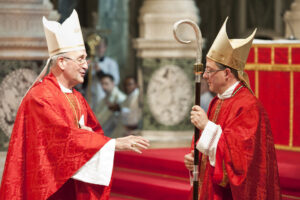
 In an interview with John-Henry Westen, Bishop Athanasius Schneider offers a critical assessment of the liturgical reforms that followed Vatican II. He argues that the present form of the Novus Ordo does not faithfully reflect either the intentions of the Council Fathers or the actual text of Sacrosanctum Concilium. Instead, he advocates a gradual “reform of the reform” aimed at restoring the sacred character of the Roman Rite.
Below are several key points, expressed in the bishop’s own words.
The Novus Ordo Cannot Continue as It Is
“The Novus Ordo, as it is, cannot continue in such a way. This is not even what Vatican II had in mind at all.
First, it does not correspond to the text itself or to the intention or to the mind of the Sacrosanctum Concilium, because there it is said, “there should not be novelties introduced” (SC 23). But there were enormous novelties introduced in the Novus Ordo.
The Council continues to say that only novelties in an organic manner which already existed (are allowed)—but you see, there are so many elements in the Novus Ordo which did not exist; they were simply invented on the table according to a Protestant-Jewish prayer.
Secondly, it was in the debates in the Acta where they are reported, the protocols of the debates of all Church—all Council fathers who made their contribution orally or in writing during the Council. It is a volume that contains all these in Latin. We must read it. I read it twice, and almost the entire majority of the discussions were around the vernacular language and Latin. But no more; the Council fathers were not so much engaged in proposing such concrete reforms of the Holy Mass. No.”
The “True” Mass of Vatican II
“So in ’65, in the beginning, the Pope already approved a new Order of Mass according to the decisions of the Council. So it was the first—this is the true Mass of Vatican II, that of ’65. This Mass, when the Council fathers returned to the last session in September ’65, they already celebrated this reformed order, but it was very cautious; it was very slightly reformed without ruptures as the Council text demanded.
It is basically the ’65 Mass—I call this the true Vatican II Mass, not that of the ’70. The structure is basically the same. All the rubrics almost the same. Only Psalm 42 at the beginning was taken away. But it was not a complete novelty because even before the Council… it was also removed. Then the second one was that the last Gospel of John was also removed. And the rest was not changed at all. It remained with the Canon—only the Roman Canon—, and it was obligatory in Latin. Even though it was still kept that the Canon was prayed by the priest silently in ’65. This is the Mass of Vatican II.”
The Proposed Path Forward
“So I think that first step is that the Traditional Latin Mass as it is should be kept, not changed, because of the old, venerable age of this rite which was in this form celebrated, I would say, almost a thousand years, a millennium.
It is not the Tridentine Mass at all. I speak not of the Missal but of the order. Because of this venerable age, I would propose not to change but leave it as it is. And then to proceed step by step to reform the Novus Ordo towards the Traditional Form… so that then after time, the so-called Novus Ordo… would be basically the same as the old one. Except that the use of the vernacular language would be, I think, more present. It would be a slight variant.”
The Five Essential Elements of Reform
1. Orientation of the Priest
“I think that the first, most important change for the Novus Ordo should be that all the Masses should be celebrated towards the Lord…It should be an order of the Pope, compulsory. Because this form [facing the people] is contrary to the Apostolic Tradition, to the meaning of prayer itself. We must go out from this sickness of anthropocentric worship. This style—we basically give a message: it is about us, it’s not about God.”
2. Manner of Receiving Communion
“The second, almost the same importance, is that all should receive Communion on the tongue and kneeling. The current situation with the Communion in the hand is the deepest wound in the Church. Such mass desecrations are going on. Materially, so many fragments fall down and are trampled. It is our greatest treasure… and this through Holy Communion is treated in such a banal, everyday manner like taking common food.”
3. Removal of Feminism from the Sanctuary
“The ladies should not be more during Holy Mass, acting at the altar. There should not be acolytes or altar servers or even lectors—readers of the Holy Scripture during Holy Mass—in the sanctuary. It is contrary to the Apostolic Tradition. It is giving a sign of introducing feminism in the core of Liturgy… a kind of promotion of giving women access step by step to the holy ministry. We must stop this feminism at the altar. A true Catholic girl and woman would never go to the altar during Holy Mass. Would you imagine that Our Lady would go to the altar and there act as altar lady and reader on the pulpit? Never.”
4. Sacred Music
“Reformed, of course, the music to return to a dignified sacred music. To stop these Protestant-style, Pentecostal forms of guitars and so on. This is not worthy of Catholic worship. This is worldly and goes in the direction of paganism.”
5. Increased Use of Latin
“To use more Latin. It could be done when the Pope will issue a norm that… in every cathedral, shrine, or greater church, should be at least once a month the entire Mass… be celebrated in Latin. And for religious, it should be compulsory that the conventional Mass of every day should be in Latin.”
Reference: LSNTV. (2026, January 14). Bishop Schneider’s WARNING: ‘Novus Ordo CANNOT Continue As Is’ [Video]. YouTube.