Bishop Schneider questioned Pope Francis on religious diversity and criticized the Vatican abuse summit for ignoring root causes such as homosexuality and moral relativism, emphasizing a need for deeper love of Christ.
Bishop Schneider welcomes Cardinal Müller’s Manifesto as vital for faith clarity, condemns Cardinal Kasper’s rejection, and calls for a united, faithful resistance against doctrinal confusion and neo-gnostic distortions in the Church.
Bishop Schneider declared Christianity the only God-willed religion, opposing religious pluralism in the Abu Dhabi document, and emphasized Jesus as the sole way, truth, and life, with true brotherhood found only in Christ.
Bishop Schneider stated clerical sexual abuse stems mainly from homosexual vice and moral relativism, warning the Vatican summit will fail without confronting these issues and the existence of homosexual networks in the Church.
Bishop Schneider received a verbal Vatican order to reduce foreign trips, highlighting a pattern of silencing critical voices while others receive leniency, reflecting unease with open criticism within the Church hierarchy.
Bishop Schneider critiques the Youth Synod’s sentimental language and papal-approved document, stresses non-infallibility of such teachings, and warns that frequent deliberative synods risk conciliarism and distract bishops from prayer and evangelization.
Bishop Schneider says the Vatican Youth Synod document shows sentimentalism and that senior clergy used youth to push agendas, avoiding key issues like homosexuality’s role in sexual abuse and promoting ambiguous doctrines.
Bishop Schneider’s extensive interview discusses key Church issues, including Vatican II, Amoris Laetitia, liturgy, and youth synod, available as a free e-book titled Catholic Church: Where Are You Heading?
Bishop Schneider supports Archbishop Viganò’s sworn testimony accusing Pope Francis of covering up abuse, urging complete transparency in the Church, especially from the Pope, despite the gravity of accusing a reigning pope.
Bishop Schneider warns that LGBT ideology threatens the Church, likening it to early Christian persecution. He criticizes clergy supporting “gay pride” and calls for a proper Catholic response in his statement.
Bishop Schneider condemned gay adoption as moral abuse, supporting Catholic agencies refusing placements with same-sex couples. Philadelphia ended contracts with such agencies, leading to a federal lawsuit over religious freedom violations.
Bishop Schneider stresses liturgical reverence, family apostolates, and local vocations. Challenges in Kazakhstan include clergy shortage, fragmented families, and vast distances between communities, hindering consistent pastoral support and Church development.

Bishop Schneider calls European migration a plan to alter Christian identity, labels the EU a “new Soviet Union,” and denounces doctrinal confusion, intercommunion for non-Catholics, and same-sex parenting as grave moral issues.
Bishop Schneider traces Eucharistic devotion’s history, its decline after Vatican II, and a revival through perpetual adoration, while explaining how the Rosary complements the Mass in deepening participation in the Gospel mysteries.
Bishop Schneider, awarded in Winnipeg, reaffirmed Humanae Vitae’s teaching on procreation, urged reliance on grace for conjugal chastity, and reflected on the Church’s enduring mission amid persecution and societal challenges.
Bishop Schneider opposes married priest ordination, upholds priestly continence, and warns against expanded female ministry. He encourages the faithful, seeing hope in small groups supported by the Holy Spirit amid Church challenges.
The Conference of Catholic Families will run alongside the Vatican’s WMOF, promoting traditional Church teachings on sexuality. Organizers aim to support clarity amid perceived confusion, not to compete with the main event.
Bishop Schneider received an award for defending Catholic teaching. Dr. Kwasniewski praised his fidelity, especially in liturgy and doctrine, calling him a rock amid spiritual and moral challenges in the Church.
Bishop Schneider highlights the Eucharist as Christ’s living sacrifice, calling for reverent worship and unshakable faith. He affirms the traditional Mass as a vital expression of Catholic liturgical and spiritual continuity.
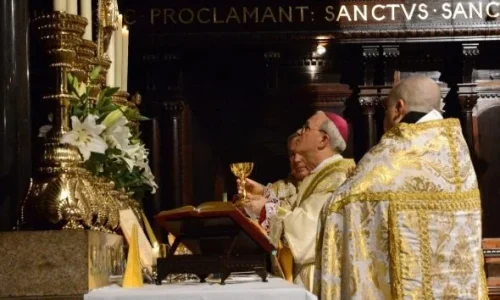
Bishop Schneider celebrated a well-attended Pontifical High Mass for Whit Thursday in London, assisted by several clergy. Music was provided by Cantus Magnus, and event photographs were taken by John Aron.
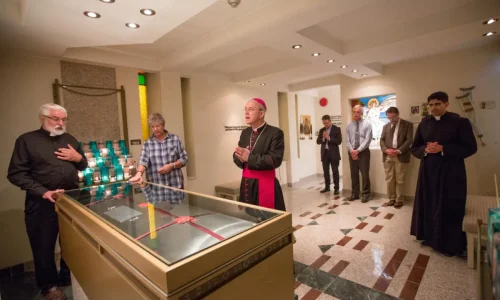
His Excellency spent a considerable amount of time in the museum and the shrine. He was most appreciative of the artifacts, especially those of the underground church.
Bishop Schneider denounces Eucharistic irreverence, opposes intercommunion, affirms unchanging Church teaching on marriage, and calls for a new syllabus of errors to address doctrinal confusion following the Second Vatican Council.
Bishop Schneider rejects blessings of homosexual couples, female priesthood, and Protestant intercommunion, urging fidelity to apostolic tradition. He calls for a new Syllabus of Errors to combat widespread doctrinal distortion.
Bishop Schneider recalled the Arian crisis to urge Catholics to reject modern heresy, even from bishops, by holding fast to the Church’s timeless doctrine, upheld historically by faithful laity.
Opponents of Amoris Laetitia gathered in Rome to affirm traditional teachings on marriage, criticize papal overreach, and call for correction, asserting that truth isn’t determined by majority opinion.
Bishop Schneider’s visit to California drew large crowds to Latin Mass events and conferences, reflecting strong interest in his defense of tradition, shaped by his faith under Communist persecution.
Bishop Athanasius Schneider celebrated a Pontifical Mass at St. Stephen of Hungary Parish in Allentown, PA, drawing faithful from afar. A brunch and talk followed the well-attended liturgical celebration.
Bishop Schneider and others defend Church teaching on marriage through a Profession, opposing Communion for the divorced and remarried, calling bishops worldwide to uphold doctrinal clarity against confusing pastoral norms.
Amoris Laetitia’s guidance on Communion for divorced and remarried Catholics has sparked division among bishops. Some embrace case-by-case discernment; others demand doctrinal clarity, warning against contradictory pastoral practices and confusion.
Bishop Schneider says Amoris Laetitia promotes sin under the guise of discernment, allowing adulterers to receive Communion and threatening Church teaching on marriage, sexuality, and sacramental integrity.