Introduction
The Traditional Latin Mass — often called the Mass of the Ages — is the Roman Rite as organically developed and celebrated for centuries within the Catholic Church. It stands not as a relic of the past, but as a living expression of sacrificial worship rooted in Sacred Scripture and Apostolic Tradition.
The Holy Sacrifice of the Mass flows directly from the institution of Christ at the Last Supper and His redemptive offering upon Calvary.
“For this is my body… For this is my blood, which shall be shed for many” (Matthew 26:26–28).
https://www.drbo.org/chapter/47026.htm
The Traditional Latin Mass preserves this sacrificial and priestly theology with clarity, reverence, and continuity.
What This Hub Page Is
This page serves as a central doctrinal resource on the Traditional Latin Mass. It gathers together:
- Historical foundations
- Theological principles
- Biblical roots
- Practical guidance
- Frequently asked questions
It presents the Mass of the Ages in light of Sacred Scripture, the Council of Trent, the Roman Catechism, and the perennial Magisterium.
The Council of Trent solemnly affirmed that saving truth and moral discipline are preserved in written books and unwritten traditions received from the Apostles.¹
https://www.newadvent.org/cathen/15030c.htm
The Traditional Latin Mass stands within this uninterrupted transmission.
Why the Traditional Latin Mass Matters
The Mass is the heart of Catholic life. When its sacrificial nature is obscured, Eucharistic faith weakens.
The Council of Trent defined that in the Mass, the same Christ who offered Himself once upon the Cross is offered in an unbloody manner.²
https://www.newadvent.org/cathen/09789c.htm
The Traditional Latin Mass expresses this doctrine unmistakably through:
- Sacrificial language in the Offertory
- Sacred silence during the Canon
- Orientation toward God
- Kneeling in adoration
Liturgy shapes belief. When worship emphasizes sacrifice and transcendence, faith is strengthened.
Who This Serves
This hub page serves:
- Clergy and seminarians seeking doctrinal continuity
- Traditional Catholics devoted to the Mass of the Ages
- Families desiring reverent worship
- Converts exploring Catholic liturgical theology
- Marian devotees seeking deeper Eucharistic understanding
It is written for those who desire fidelity rather than novelty.
Historical Foundations of the Traditional Latin Mass
Apostolic Worship
The Eucharistic sacrifice began at the Last Supper and continued in apostolic worship.
“They were persevering in the doctrine of the apostles, and in the communication of the breaking of bread” (Acts 2:42).
https://www.drbo.org/chapter/51002.htm
The early Church’s liturgical structure — Word, offering, consecration, communion — remains visible in the Traditional Latin Mass.
Organic Development Through the Centuries
The Roman Rite developed organically, preserving apostolic substance while deepening ceremonial expression.
Saint Vincent of Lérins described authentic development as growth “in the same sense and the same judgment.”³
https://www.newadvent.org/fathers/3506.htm
The Traditional Latin Mass embodies this principle. It reflects continuity, not rupture.
The Codification After Trent
In response to doctrinal confusion, the Council of Trent clarified Eucharistic theology.²
The Missal promulgated under Saint Pius V preserved the Roman Rite as it had been handed down. This act was one of safeguarding, not innovation.
The Mass of the Ages remained substantially unchanged for centuries, reflecting liturgical stability rooted in theological precision.
Theological Foundations of the Traditional Latin Mass
The Mass as the Renewal of Calvary
The Holy Sacrifice of the Mass is not a new sacrifice, but the sacramental re-presentation of the one sacrifice of Christ upon the Cross.
Saint Paul teaches:
“For as often as you shall eat this bread, and drink the chalice, you shall shew the death of the Lord, until he come” (1 Corinthians 11:26).
https://www.drbo.org/chapter/53011.htm
The Council of Trent solemnly declared that in the Mass, the same Christ who offered Himself on the altar of the Cross is offered in an unbloody manner.²
https://www.newadvent.org/cathen/09789c.htm
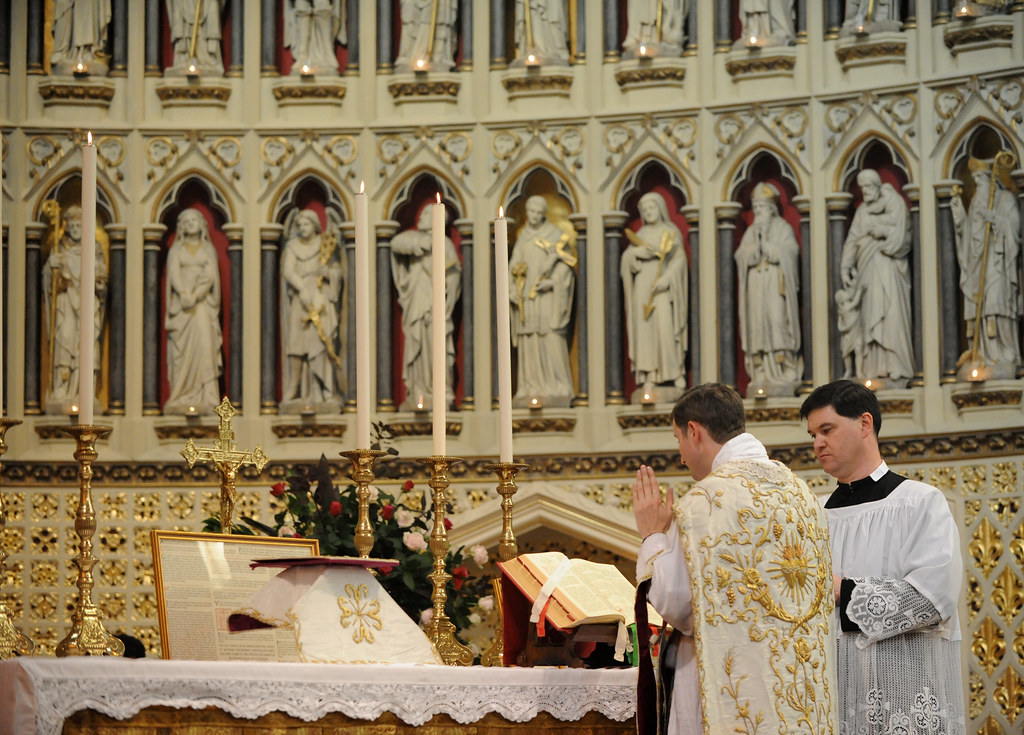
The Traditional Latin Mass makes this sacrificial dimension unmistakable through:
- The Offertory prayers
- The language of oblation
- The solemn Canon
- The elevation and adoration
The altar is the place of sacrifice. The priest acts in persona Christi, offering the Holy Victim to the Father.
The Real Presence and Transubstantiation
Christ’s teaching in the Bread of Life discourse is clear:
“My flesh is meat indeed: and my blood is drink indeed” (John 6:56).
https://www.drbo.org/chapter/50006.htm
The Church defined the doctrine of transubstantiation at the Council of Trent to safeguard this Scriptural truth.⁴
https://www.newadvent.org/cathen/14774a.htm
In the Traditional Latin Mass, this belief is reflected in:
- Genuflections
- Prolonged silence
- Kneeling for Holy Communion
- The careful purification of sacred vessels
Reverence flows from belief.
Ad Orientem: Worship Directed to God
Throughout Scripture, worship is directed toward God rather than toward the assembly.
“I will go in to the altar of God” (Psalm 42:4).
https://www.drbo.org/chapter/21042.htm
In the Traditional Latin Mass, priest and faithful face the same direction — symbolically toward the Lord.
This posture expresses unity before God and reinforces the vertical dimension of worship.
The Heavenly Liturgy Reflected on Earth
The Book of the Apocalypse reveals heavenly worship filled with:
- Altars
- Incense
- Prostration
- Sacred hymns
“And another angel came, and stood before the altar, having a golden censer” (Apocalypse 8:3).
https://www.drbo.org/chapter/73008.htm
The ceremonial solemnity of the Traditional Latin Mass mirrors this Scriptural vision of heavenly liturgy.
Earthly worship participates in heavenly reality.
Core Resources in This Section
How to Attend the Traditional Latin Mass
Practical guidance for preparation, posture, silence, and interior participation in the Holy Sacrifice.
Biblical Foundations of the Traditional Latin Mass
A Scriptural exploration of sacrifice, priesthood, covenant, and heavenly worship.
Guide to Traditional Catholic Terms
Doctrinal explanations of essential theological terms such as:
- Transubstantiation
- Holy Sacrifice
- Sacred Tradition
- Ad orientem
- Deposit of Faith
Why This Matters for the Faithful Today
Modern culture often emphasizes community and self-expression. Scripture and Tradition emphasize sacrifice and divine transcendence.
Saint Paul warns:
“Whosoever shall eat this bread, or drink the chalice of the Lord unworthily, shall be guilty of the body and of the blood of the Lord” (1 Corinthians 11:27).
https://www.drbo.org/chapter/53011.htm
Such language presupposes a sacred and substantial presence.
The Traditional Latin Mass safeguards this Scriptural realism and fosters Eucharistic reverence.
Where reverence increases, faith deepens.
Where sacrifice is remembered, redemption is understood.
Frequently Asked Questions
Is the Traditional Latin Mass part of the Catholic Church today?
Yes. It is the Roman Rite in its historic form and remains within the life of the Church.
Why is Latin retained?
Latin preserves doctrinal precision and universality. It expresses continuity across centuries and cultures.
Is the Mass primarily a meal?
No. While it includes sacred communion, the Church teaches that it is truly and properly a sacrifice.²
Why does the priest face the altar?
Because the Mass is offered to God. Priest and faithful together turn toward the Lord in common worship.
Is this form of the Mass resistant to renewal?
Authentic renewal flows from fidelity. As Saint Vincent of Lérins teaches, development must occur “in the same sense and the same judgment.”³
Final Exhortation
The Traditional Latin Mass stands as a visible sign of the Church’s continuity through the centuries.
It is rooted in Scripture.
It is clarified by councils.
It is nourished by Sacred Tradition.
In every age, the Holy Sacrifice remains the center of Catholic life.
May the faithful rediscover the theological depth and Scriptural richness of the Mass of the Ages, and may devotion to the Immaculate Heart lead all souls to deeper Eucharistic reverence.
May the Reign of Mary come.
Adveniat Regnum Mariae!
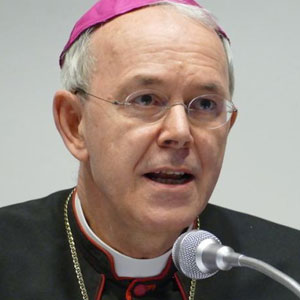
Have more questions about tradition and the faith? Find clear and faithful answers in our Q&A with Bishop Athanasius Schneider: https://www.gloriadei.io/q-and-a/
Footnotes
- Council of Trent, Session IV, Decree Concerning the Canonical Scriptures (1546).
https://www.newadvent.org/cathen/15030c.htm - Council of Trent, Session XXII, Doctrine on the Sacrifice of the Mass (1562).
https://www.newadvent.org/cathen/09789c.htm - Saint Vincent of Lérins, Commonitorium.
https://www.newadvent.org/fathers/3506.htm - Council of Trent, Session XIII, Decree on the Most Holy Eucharist (1551), on Transubstantiation.
https://www.newadvent.org/cathen/14774a.htm - Holy Bible, Douay-Rheims Version. Matthew 26:26–28.
https://www.drbo.org/chapter/47026.htm - Holy Bible, Douay-Rheims Version. Acts 2:42.
https://www.drbo.org/chapter/51002.htm - Holy Bible, Douay-Rheims Version. 1 Corinthians 11:26–27.
https://www.drbo.org/chapter/53011.htm - Holy Bible, Douay-Rheims Version. John 6:56.
https://www.drbo.org/chapter/50006.htm - Holy Bible, Douay-Rheims Version. Psalm 42:4.
https://www.drbo.org/chapter/21042.htm - Holy Bible, Douay-Rheims Version. Malachi 1:11.
https://www.drbo.org/chapter/43001.htm - Holy Bible, Douay-Rheims Version. Apocalypse 8:3.
https://www.drbo.org/chapter/73008.htm
Bibliography
Sacred Scripture
Holy Bible. Douay-Rheims Version.
https://www.drbo.org
Ecumenical Councils
Council of Trent. Session IV, Decree Concerning the Canonical Scriptures (1546).
https://www.newadvent.org/cathen/15030c.htm
Council of Trent. Session XIII, Decree on the Most Holy Eucharist (1551).
https://www.newadvent.org/cathen/14774a.htm
Council of Trent. Session XXII, Doctrine on the Sacrifice of the Mass (1562).
https://www.newadvent.org/cathen/09789c.htm
Fathers of the Church
Saint Vincent of Lérins. Commonitorium.
https://www.newadvent.org/fathers/3506.htm