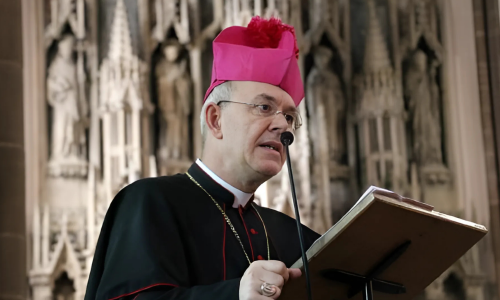
Bishop Schneider warns that marriage and the family face a global attack from anti-Christian forces, urging clear defense of God’s plan for human nature and the strengthening of family life within the Church.
Bishop Schneider highlights Karaganda as a Stalinist Gulag site where millions, especially Christians and Catholics, were deported and killed, stressing intense persecution while affirming the survival of faith and the Church.
Secular music in church undermines worship. Bishop Schneider urges a return to Gregorian chant, which uplifts the soul. Youth crave depth, not noise, they respond deeply when exposed to sacred tradition.
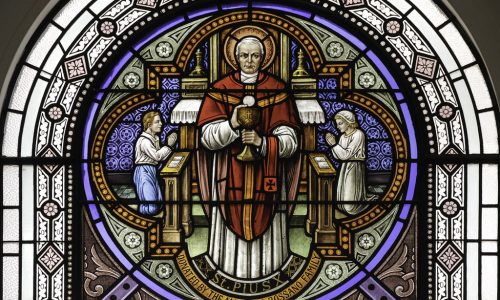
Bishop Schneider explains the canonical status of the Priestly Society of Saint Pius X, affirming legitimate papal permissions, rejecting denial of these facts, and stressing doctrinal clarity and fidelity to tradition.
Bishop Schneider warns that Freemasonry, under secret rituals and initiation, historically opposes law, property, and religion, influencing revolutions and society, maintaining membership and loyalty despite opposition, and embodying a hidden political force.
We must stay faithful to God, not the world, even if accused of being homophobic. These accusations are false, and we must respond clearly while upholding God’s truth over public opinion.
Approving female deacons would be heresy. The Pope has no authority to change divine Church order. Faithful must resist, and a future Pope or Council would ultimately condemn the error.
Families should avoid irreverent Masses and preserve faith at home if needed. Traveling for a worthy Mass is preferable. In times of persecution, the domestic church sustained the faithful.
Bishop Schneider stresses unwavering Catholic faith, inspired by saints’ martyrdom, warns against modern compromises, and emphasizes living faith through love, works, and adherence to Church teachings as essential for truth and salvation.
Bishop Schneider stresses the Eucharist, holy Mass, and the example of saints and priests as essential for deepening faith, guiding the faithful to Christ, and safeguarding against spiritual error.
Fifty years of relativism and false ecumenism have led to denying the need to convert Muslims. This betrays Christ by withholding the truth of the Holy Trinity and true salvation.
Christ, the true and invisible head of the Church, guides it infallibly, even through a defective Pope. He uses His vicar as an instrument, despite the Pope’s imperfections.
The Pope is not infallible in all things or free from error. This basic Catholic teaching, found in old catechisms, must be remembered and shared, as it is often forgotten.
The Church is stronger than a Pope who errs morally or doctrinally. It endures even when a Pope spreads error or supports harmful ideologies, as seen in the present time.
The Church’s renewal depends decisively on reverent and fruitful Holy Communion, received with true interior and exterior reverence, aiming to increase faith and devotion in the Holy Eucharist.
Bishop Schneider highlights the Church’s crisis, urging Catholics to resist evil, uphold faith, and rely on Christ and the Eucharist for protection, courage, and victory over worldly and anti-Christian influences.
Bishop Schneider defends traditional liturgy, critiques false progress and sexual immorality, and stresses natural law and God’s commandments. He affirms the Catholic Church as the only true religion, even for states.
The crisis in the Church stems from synodality, replacing God with worldly desires. By compromising and avoiding clarity, the Church lives in cowardice. A new ascent begins by defeating cowardice.
Want to grow in the Catholic faith? Watch His Excellency, Bishop Athanasius Schneider. His clear, faithful teachings offer truth, reverence, and guidance rooted in Scripture, Tradition, and Church doctrine.
Kazakhstan’s small Catholic minority faces challenges of distant communities and few local priests. Despite peaceful interfaith relations, the Church seeks growth through training native clergy for future stability.
Ivan Metz, a young layman devoted to faith and traditional liturgy, offers a timely example. His writings inspire Christian life and holiness, especially for young men today, deserving canonization.
Bishops and cardinals published documents clarifying Amoris Laetitia ambiguities and addressing widespread Church errors, including clarifications on the Dubia, through a 2017 statement and a later declaration listing forty errors.
Authentic ecumenism respects mutual freedom without conditions. Canonization should rely solely on the Church’s judgment, free from outside pressures or political tactics, preserving genuine respect and faith.
Unrepentant supporters of abortion must not receive Communion. Allowing it causes spiritual harm, scandal, and undermines Catholic teaching. Clergy permitting this commit grave sin and contradict the Church’s faith.
Christ’s Passion, death, and burial under Pontius Pilate fulfilled prophecy and redeemed humanity. He suffered voluntarily to conquer sin and death, forming the foundation of Christian faith and demonstrating God’s love.
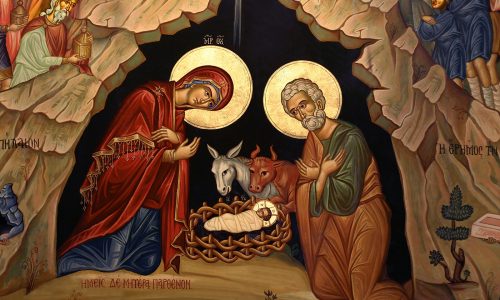
Christ, truly God and man, was conceived by the Holy Spirit and born of the Virgin Mary. This mystery affirms His divinity, humanity, and the Church’s rejection of Incarnation-related heresies.
Jesus Christ is the anointed Prophet, Priest, and King, the Only-begotten Son of God, true God and Man, and our Lord who reigns in the house of Jacob forever with no end to His kingdom.
Jesus Christ is the eternal, only-begotten Son of God, true God and true Man. His name, meaning “Saviour,” was divinely given and holds power, holiness, and necessity for human salvation.
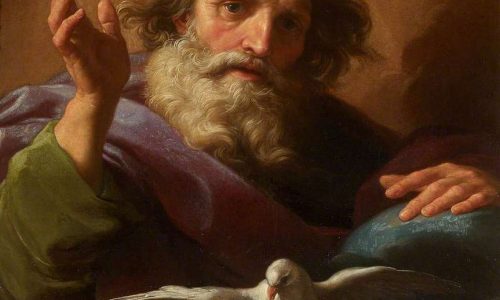
The Most Holy Trinity, Father, Son, and Holy Spirit, is one God in three persons. This mystery, revealed by Christ, underlies all faith and is lived by grace through divine indwelling in believers.
Belief in one God means trusting in the all-wise, eternal Creator who governs all things. True faith rejects doubt and seeks not proof, but reverent submission to divine revelation and providence.