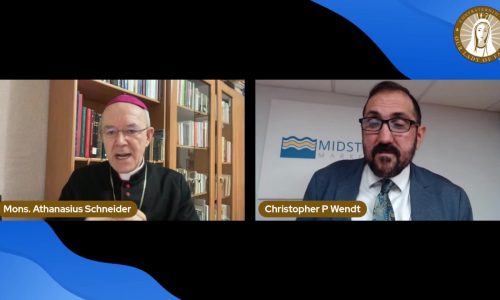
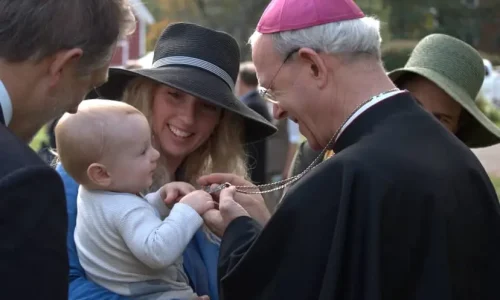
Bishop Schneider denounces Fiducia supplicans for contradicting God’s law on marriage, urging bishops to reject it and priests to refuse such blessings, warning it spreads doctrinal confusion and moral relativism within the Church.
Bishop Schneider condemns blessing gay unions as blasphemy, critiques Pope Francis’ Synod, and calls on Catholics to resist, sharing insights from his underground Church experience under communist rule.
Bishop Schneider’s Credo aims to clarify doctrinal confusion, challenge relativism, correct Vatican II ambiguities, condemn Freemasonry, and critique the Synod on Synodality’s lack of focus on evangelization and clear teaching.
Bishop Schneider urges Catholics to live and witness amid corruption, uphold sacramental family life, restore true fatherhood, and cherish the traditional Mass, which manifests divine order and guards against modern errors and moral confusion.
Bishop Schneider calls John Paul II’s 1984 consecration imperfect for omitting Russia’s name and urges a future explicit consecration, believing Russia and the Orthodox Church would view it positively as a charitable Marian act.
Bishop Schneider affirms the Eucharist as the veiled yet real presence of Christ’s divinity and humanity, teaching that outward reverence sustains faith in the Incarnation, while neglecting it diminishes belief in this supernatural mystery.
Bishop Schneider urges Pope Francis to revoke synodal voting changes equating laity and bishops, warning they reflect Modernism and secular influence, and calls for fidelity to apostolic tradition and divine Church order.
Bishop Schneider warns that Modernism and secularism obscure the supernatural, replacing prayer with endless meetings. He calls for renewed adoration, holiness, and authentic pastoral encounters with the faithful instead of bureaucratic “synodality.”
Bishop Schneider describes his vocation from childhood faith in Soviet Kyrgyzstan to priesthood in the Canons Regular, missionary service, and episcopacy, encouraging believers to grow in faith, love Christ, and seek salvation in Him.
Bishop Schneider cites relativism, clergy fear, and poor formation as causes of Church confusion, urging clear teaching, repentance, vigilance, laity involvement, and faithfulness amid crises, with historical precedents and ongoing renewal by the Holy Spirit.
Bishop Schneider condemns bishops permitting Communion for sinners as contradictory to Church teaching, caused by poor formation, relativistic thinking, and lack of personal relationship with Christ, rooted in pre-Vatican II influences.
God rejects evil while loving sinners, seeking their repentance. The Church must guide the lost to holiness. Divine punishments exist, but their timing and manner are unknown, requiring vigilance and warning others.
Bishop Schneider states that persecution often follows internal Church crises and can serve as purification. Catholics should be spiritually prepared for moral or physical martyrdom, strengthening faith and trusting God for strength.
Bishop Schneider emphasizes the Church’s primary mission: saving souls through Christ and the sacraments. Social justice is secondary, primarily the responsibility of the laity, not the clergy.
Bishop Schneider calls this the laity’s hour: to witness Christ, defend family and faith, and support the Church internally, fulfilling their special mission highlighted by Vatican II.
Bishop Schneider defends the traditional Latin Mass as essential, critiques modern reforms and restrictions, and promotes his book to revive reverent, God-centered worship and engage young Catholics in the Church.
Bishop Schneider highlights the traditional Mass’s beauty and clarity, advising youth to deepen faith, live sacramentally, cultivate courage, and embrace vocations in family or consecrated life to remain faithful Catholics.
Bishop Schneider proposes a foundation offering temporary financial aid to families whose fathers lose jobs, especially for those who refuse involvement in the fetal industry out of moral and religious conviction.
Bishop Schneider highlights misinterpretations of Vatican II, urging magisterial clarification on collegiality, worship, creation, unity, and religious liberty, emphasizing adherence to tradition and avoiding anthropocentric distortions in the Church and society.
Bishop Athanasius Schneider explains the mission of the Mothers of the Holy Cross, their charitable and missionary work in Tanzania and Germany, and their need for support to build a new nursing home and adoration church.
Bishop Schneider teaches that all creation belongs under Christ’s rule. Societies rejecting Him collapse, while believers must trust God, uphold natural law, and accept trials as divine purification leading to eternal life.
Bishop Schneider discusses Theology of the Body, supports restoring reverent liturgy, promotes veiling and Communion on the tongue, and explains that Pope Francis’s consecration of Russia fulfills Our Lady of Fatima’s request.
Bishop Schneider calls for restoring reverent, Christ-centered liturgy, warning that modern anthropocentrism distorts the Mass. His book urges a return to tradition to heal the Church's Eucharistic crisis and spiritual weakness.
Bishop Schneider critiques Vatican restrictions on private Masses, cautions against excesses in the Charismatic movement, and urges reverence and restraint in the use of extraordinary ministers distributing Holy Communion.
Bishop Schneider denounces new Vatican restrictions on the traditional liturgy, urging bishops to resist unjust measures. He calls for transparency, pastoral care, and faithfulness to guarantees made to traditional communities.
Bishop Schneider highlighted U.S. Catholic vitality, criticized Pope Francis’ focus on health over clarity, opposed transhumanism, urged Russia’s consecration, and emphasized prayer, Eucharistic devotion, and restoring true human values and dignity.
Bishop Schneider notes growing signs of end times but urges vigilance over speculation. He believes in a future spiritual renewal, as foretold by Our Lady of Fatima through Russia’s conversion and peace.
Bishop Schneider criticizes Pope Francis’ ambiguity, urges clarity in teaching, and laments episcopal silence. He finds hope in lay Catholics and young priests who uphold and spread the faith courageously.
Bishop Schneider asked Pope Francis to clarify the Abu Dhabi document's phrase on religious diversity. The Pope explained it as God’s permissive will and later sent Schneider a personal note and speech copy.